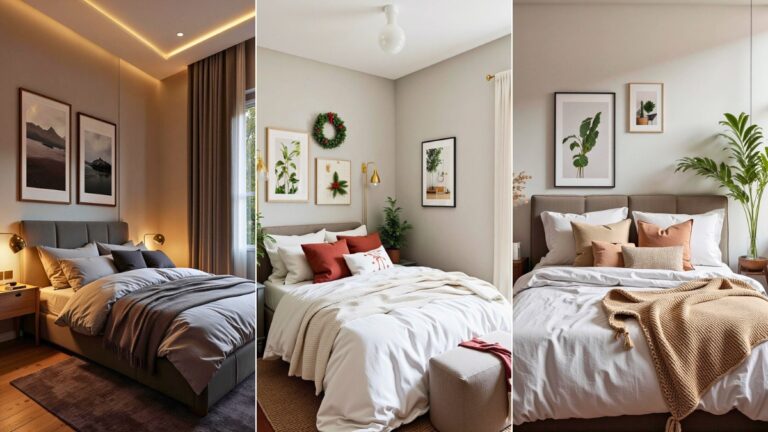
26 New Year Home Decor Ideas That Actually Feel Like a Fresh Start (Not Just a Pinterest Board)
I spent the first week of January staring at a blank wall in my living room. Not a metaphorical blank wall — an actual, completely empty wall where a gallery arrangement used to hang.
I had taken everything down to “refresh” the space, got overwhelmed, and left it bare for eleven days.
My partner started calling it “the void.” So when I say I understand the urge to reset your home for the new year, I mean I really understand it — including the part where it spirals into indecision and you end up with a sad empty wall for almost two weeks.
Here’s the thing about New Year home decor: most “refreshes” fail because people either try to change everything at once, or they buy a bunch of seasonal junk that’s packed away by February.
The approach that actually works is smaller, weirder, and more personal than that. It’s about the specific things that make a space feel like yours — not a showroom, not a trend mood board, just a place you actually want to be in on a Tuesday night in January when it’s dark at 4:45 p.m.
I’ve tried most of what’s below across two apartments, one rental house with beige carpet I couldn’t change, and a lot of trial and error.
Some of these are things I’d spend real money on. Others are things I’d skip. I’ll tell you which is which.
1. Ditch the All-White Kitchen — Warm Neutrals Are In
The glossy, all-white kitchen has been the default for years, and 2026 is officially over it. Designers are pushing warm, rich neutrals instead — espresso browns, deep terracottas, and saturated greens that make a kitchen feel like a room you actually cook in rather than a showroom you’re afraid to splatter.
You don’t need to repaint your cabinets to participate. I swapped my white ceramic canisters for a set in warm terracotta and added a woven runner in a deep brown. Total cost: about $40. The kitchen immediately felt less sterile. Apartment Therapy’s trend report specifically calls out “Espresso Bean,” “Warm Mahogany,” and “Martini Green” as the colors to watch — but you can pull those in through textiles, dishware, and small accessories without touching a paintbrush.
Pro tip: If you do want to repaint, start with the smallest surface. A single accent wall behind open shelving or a statement island is the low-commitment version. Painting an entire kitchen the wrong brown is a very expensive lesson my friend Priya learned the hard way.
2. Layer Your Lighting Like You Mean It
Lighting is the single biggest change you can make for the least money, and most people still have one sad overhead fixture doing all the work. Adding a second and third light source — even cheap ones — changes how a room feels more than any paint color or piece of furniture.
I bought a $20 battery-operated table lamp from Amazon and put it on my kitchen counter where there’s no outlet. It runs on rechargeable batteries and gives me a soft pool of light when I’m making tea at 9 p.m. It’s not going to win any design awards, but it made the kitchen feel less like an office break room.
Pro tip: Replacing your lightbulbs is free-ish and takes five minutes. Swap cool-white bulbs (anything above 3000K) for warm-white (2700K) in every lamp you own. You’ll be shocked at how much cozier everything feels.
3. Add Natural Textures — The Quiet Hero of a Good Room
A linen throw, a woven basket, a ceramic vase, a nubby pillow. This is the stuff that makes a room feel layered without making it feel cluttered. The key is texture, not stuff. One good basket does more work than five plastic organizers from the dollar store.
I had a corner in my bedroom that was just… nothing. A dead zone. I put a tall woven basket there — the kind that’s technically for laundry but works just as well as a decorative element — and it made the corner feel intentional. Cost: $28 at HomeGoods. The corner now looks like I planned it.
Pro tip: Wicker, wood, and stone are the textures designers are gravitating toward for 2026. If you’re not sure where to start, look for anything with visible grain or weave.
4. Fix the Entryway Before You Do Anything Else
The entry sets the tone for your whole home, and it’s the space people see first. If your entryway is a pile of shoes and a stack of unopened mail, no amount of living room decor will fix how the apartment feels when you walk in.
I hung two rows of Command hooks — one at adult height, one lower for bags and keys — and added a small console table from IKEA. The total was under $80 and the change was dramatic. A small tray for keys and a bowl for spare change stopped the mail pile from forming. If you have a tiny entry, a wall-mounted shoe rack or an over-the-door organizer does the same job in less space. Skip the free-standing shoe rack if your entry is narrower than about three feet — it just becomes another thing to trip over.
Pro tip: A runner rug in the entryway protects your floors and makes the space feel finished. Measure carefully — a rug that’s too small looks worse than no rug at all.
5. Swap Out Heavy Winter Textiles for Lighter Layers
This is the single easiest post-holiday refresh: put away the chunky knit throws and heavy velvet pillows. Replace them with lighter cotton, linen, or even a waffle-weave blanket in a soft neutral. You’re not changing furniture — you’re changing weight, and that’s enough to make a room feel like it can breathe again.
I keep a plastic bin in my closet labeled “heavy textiles” and swap the contents of my throw blankets and pillow covers twice a year. It takes ten minutes and costs nothing after the first purchase.
Pro tip: If you want to participate in the “cozy Danish” trend that’s popping up in Wayfair’s 2026 data, go for a waffle-knit throw in cream or oat and pair it with a single textured pillow. One or two pieces reads as intentional. Five reads as a display.
6. Choose Curved Furniture Over Sharp Edges
Curvy furniture silhouettes are beating clean-lined furniture 69% to 31% in Apartment Therapy’s 2026 forecast. Rounded coffee tables, curved-back chairs, arched mirrors — the softness is real, and it’s not just an aesthetic choice. Curved edges make small spaces feel less aggressive and more inviting.
My friend Dana replaced her square coffee table with a round one in her 600-square-foot apartment and said it instantly made the living room feel bigger. That sounds like nonsense until you try it. Round shapes let you move around them without banging your shin, which, in a small space, is its own form of luxury.
Pro tip: You don’t need to replace furniture. An arched floor lamp, a round tray, or a curved mirror gets you 80% of the look for 20% of the cost.
7. Stop Ignoring Your Bookshelf
An unstyled bookshelf is one of the biggest “this room isn’t finished” tells. The fix isn’t buying more books — it’s arranging what you have. Group books by color or height, leave some horizontal stacks as pedestals for small objects, and mix in a plant or a framed photo. The goal is rhythm, not perfection.
I spent a Saturday afternoon pulling everything off my living room shelf, grouping it into color families, and putting it back. It took two hours. My sister walked in afterward and asked if I’d bought new furniture. That’s the power of styling.
Pro tip: Leave about 30% of the shelf surface visible. A completely filled shelf looks cramped; a completely empty one looks unfinished. The sweet spot is somewhere in the middle.
8. Use Color Drenching in One Small Room
Color drenching — painting walls, trim, ceiling, and sometimes even doors in the same shade — is having a major moment, with 66% of designers expecting it to dominate over pattern drenching in 2026. The result is a room that feels like a cocoon, which is exactly what a lot of us want in January.
This works best in small spaces you can close the door to: a bathroom, a home office, a bedroom. My friend Rachel color-drenched her tiny bathroom in a deep green and it went from “landlord special” to “I want to sit in here and read” in a weekend. Cost: about $60 in paint.
Pro tip: Color drenching a small, poorly lit room in a dark shade can make it feel like a cave in a bad way. Stick to rooms with at least one good window, or choose a mid-tone rather than something very dark.
9. Bring In Greenery — Real or High-Quality Faux
Plants change how a room feels. That’s not a design theory; it’s something you feel the moment you walk into a space with a big leafy thing in the corner versus a space without one. A pothos, a snake plant, or even a vase of eucalyptus branches adds life and movement for very little money.
I killed three plants in a row before accepting that my apartment doesn’t get enough direct light for anything fussy. Now I have a snake plant and a ZZ plant, both of which thrive on neglect, plus a $12 eucalyptus bundle from Trader Joe’s that I replace every few weeks. It’s not the lush jungle I imagined, but it’s alive and green and that’s what matters.
Pro tip: High-quality faux plants have gotten genuinely good. A friend who has a toddler and a cat (both of whom destroy real plants) swears by the faux olive tree from Nearly Natural. It’s about $70 and reads as real from two feet away.
10. Add an Accent Lamp You Actually Love
An accent lamp is the easiest way to add personality to a room without committing to anything major. A sculptural ceramic lamp on a side table, a small brass reading lamp on a nightstand, a vintage milk glass lamp on a dresser — these are the pieces that make a space feel collected rather than bought all at once.
I found a 1970s mushroom lamp at a flea market for $15 and it’s the single most complimented thing in my apartment. Nobody has ever complimented my couch.
Pro tip: Estate sales and Facebook Marketplace are goldmines for lamps. Check the cord for cracks and bring a phone charger to test whether it actually turns on before you buy.
11. The One-for-One Decluttering Rule
For every new decor item you bring into your home this year, one thing leaves. That’s it. It’s the simplest way to prevent the slow creep of stuff that makes a space feel heavy.
I started doing this in January and have gotten rid of four mugs, two throw pillows I never actually liked, and a candle holder shaped like a pineapple that I bought on a whim in 2023. My apartment doesn’t look dramatically different, but it feels lighter. That’s the point.
Pro tip: Start with the thing you keep moving from surface to surface without ever using. That’s the thing that needs to go.
12. Create a Reading Nook (Even in a Small Apartment)
Reading nooks are being called one of the defining features of 2026 homes. You don’t need a bay window or a spare room. A corner with a chair, a small side table, and a lamp is a reading nook. That’s it. The chair doesn’t need to match anything. The lamp can be the $20 battery one from earlier. The point is that you have a spot that’s designated for doing nothing productive.
I made one in the corner of my bedroom with a secondhand armchair and a $12 side table from Target. I use it maybe twice a week for twenty minutes at a time. Those twenty minutes are some of the best parts of my week.
Pro tip: If you don’t have floor space for a chair, a floor cushion and a small tray table does the same job in about two square feet.
13. Mix Your Metals on Purpose
Matching hardware is out. Mixing silver, black, gold, and bronze in the same room is in, and designers are calling it “a non-intimidating update that anyone can try”. The trick is to pick two metals and allocate them to different categories: one for lighting, one for plumbing or hardware. Brass and bronze work well together because they share warmth; matte black acts as a neutral that goes with anything.
I swapped my kitchen cabinet pulls from brushed nickel to brass and kept the faucet stainless. The kitchen looks more expensive and I spent about $30 on pulls.
Pro tip: Don’t mix more than two metals in a small space. Three reads as chaos. Two reads as intentional.
14. Try a “Micro-Makeover” Instead of a Full Renovation
Pinterest’s 2026 trend report calls “micro-makeover” the buzzword of the season — and it’s exactly what it sounds like. Instead of overhauling a whole room, you change one small thing: swap cabinet hardware, repaint a single door, upgrade a light fixture, or restyle open shelving. Each one takes an afternoon and costs under $100.
I repainted my bathroom vanity cabinet in a deep green and replaced the knobs with brass ones. Total cost: $45 and two hours. The bathroom went from “fine” to “actually nice” and I didn’t have to deal with contractors or permits.
Pro tip: Pick the surface you touch every day. Cabinet hardware and light switches are the two things you interact with constantly, so upgrading them has an outsized impact on how a room feels.
15. Rotate Your Decor Instead of Buying New
You probably own more decor than you think. The problem isn’t a lack of stuff — it’s that the same stuff has been in the same spot for two years and you’ve stopped seeing it. Rotating what you have is free and it works.
I keep a bin in my closet with “off-season” decor: vases, candle holders, small framed prints, a ceramic bowl. Every few months I swap what’s out for what’s in. It’s like shopping your own apartment.
Pro tip: Take a photo of your shelf or mantel after you style it. When you’re bored with it in three months, you’ll have a reference for how it looked before and you can just swap back.
16. Use Removable Wallpaper in a Rental
Removable wallpaper has gotten dramatically better in the last few years. It actually comes off without taking paint with it (in most cases — test a corner first). A single accent wall in a bedroom, bathroom, or entryway can transform a rental without violating your lease.
My friend Maya wallpapered the wall behind her bed in a hand-drawn floral pattern and it completely changed the room. Cost: about $80 for the wallpaper and an afternoon of swearing at the alignment. She said it was worth it.
Pro tip: Buy 15% more than you think you need. You will mess up a panel. Everyone messes up a panel.
17. Add a Statement Mirror
A mirror does double duty: it reflects light, which makes a room feel bigger and brighter, and it serves as a piece of art on the wall. An arched mirror, a vintage brass-framed mirror, a mirror with a wavy edge — these are the pieces that make a room feel designed rather than furnished.
I found an arched mirror at a thrift store for $22 and hung it in my entryway. It made the entry feel twice as big and I check my hair in it approximately forty times a day.
Pro tip: Hang a mirror opposite a window if you want maximum light reflection. Hang it opposite a TV if you want to see the TV reflected in the mirror while you’re sitting on the couch, which is honestly also a valid choice.
18. Style Your Coffee Table Like You Mean It
A bare coffee table is a missed opportunity. A styled coffee table is a small daily pleasure. The formula: one stack of books, one tray or bowl, one object that’s purely decorative, and one thing that’s alive (a plant, a candle, a bowl of fruit).
I keep a stack of three art books, a brass tray for my remote and coasters, and a small ceramic vase with a single dried stem. It takes ten seconds to reset when it gets messy, which is the real secret to a coffee table that always looks good.
Pro tip: The tray is the MVP. It corrals the small stuff so the table looks intentional even when it’s covered in your actual life.
19. Update Your Pantry, Fridge, and Junk Drawer
This is the least glamorous idea on this list and possibly the one that will make you feel the most sane. A cluttered pantry and a junk drawer full of mystery cables are background stress you don’t even notice until they’re gone. Professional organizers consistently say the pantry, fridge, and junk drawer are the first places to tackle in the New Year.
I spent a Sunday afternoon matching Tupperware lids to containers and throwing out the ones that didn’t have partners. I found four lids with no container and three containers with no lid. It was absurd and also deeply satisfying.
Pro tip: A clear bin for cables, a turntable for condiments, and a label maker are the three purchases that make the biggest difference in the kitchen. Total cost: about $40.
20. Create a “Decide Once” Zone
This one is less about decor and more about how your home functions. The idea, from professional organizer Susie Salinas, is to make decisions upfront so you don’t have to revisit them: map out where things go, where they belong, and where they don’t. A “drop zone” by the door for keys, mail, and bags; a charging station for devices; a designated spot for library books and returns.
I set up a charging station on my kitchen counter — one power strip, three cables, a small tray. Before that, chargers were scattered across every room and I could never find one when I needed it. Now they live in one place. The friction of “where is my charger” is gone.
Pro tip: The best systems are the ones you don’t have to think about. If a zone requires maintenance, it’s not a system — it’s another chore.
21. Add Warmth With a Table Lamp in the Bathroom
Bathrooms are usually lit like interrogation rooms. A small table lamp or a battery-operated sconce on the vanity or a shelf changes the whole vibe. You’re not doing anything structural — you’re just adding a second, softer light source.
I put a $25 rechargeable lamp on my bathroom counter. It runs for about two weeks on a charge and I use it every night. The overhead light stays off. The bathroom feels like a spa instead of a public restroom.
Pro tip: Look for lamps with a warm-white bulb or a dimmable setting. Cool-white light in a bathroom defeats the purpose.
22. The $5 New Year’s Decor Hack: Streamer Curtain
If you want to do something festive for New Year’s Eve specifically, this one costs almost nothing. Cut a pack of metallic streamers into strands, stick them to the ceiling above your entry or living room, and add a few balloons at the bottom. A mom on Dengarden documented the whole thing for $1.25–$5 per pack of streamers.
I did this for a small New Year’s gathering two years ago. It took twenty minutes and looked like I’d spent $50. The streamers were in the trash by January 2nd, which is honestly the correct lifespan for New Year’s decor.
Pro tip: Stick the streamers to a painter’s tape strip first, then attach the tape to the ceiling. It comes down cleaner and won’t peel paint.
23. Invest in One Piece You’ll Keep Forever
A lot of New Year decor is temporary. That’s fine. But one piece a year that you genuinely love and will keep — a handmade ceramic vase, a quality woven basket, a piece of art from a local artist — builds a home that feels collected over time rather than bought in one panic-spree at HomeGoods.
I started buying one “forever piece” per year in 2023. So far: a hand-thrown mug from a local potter, a vintage brass candlestick, and a small oil painting I found at an estate sale. None of them cost more than $50. All of them are things I’d be sad to lose.
Pro tip: Estate sales, local art fairs, and Etsy are the best sources for this. Avoid buying “forever” pieces from big-box stores — they’re designed to be replaced, not kept.
24. Comparison Table: Small-Space Decor Swaps at a Glance
| Decor swap | Best for | Approx. cost | Time | Skip if… |
|---|---|---|---|---|
| Layered lighting (accent lamp) | Any room with one overhead light | $20–$60 | 10 min | You have zero surface space |
| Natural texture (basket, throw) | Adding warmth without clutter | $15–$40 | 5 min | You’re already at max stuff capacity |
| Color drenching (small room) | Bathrooms, offices, bedrooms | $50–$80 | One weekend | The room has no natural light |
| Mixed metals (hardware swap) | Kitchens, bathrooms | $20–$50 | 30 min | You’re renting and can’t change hardware |
| Removable wallpaper | Rentals, accent walls | $60–$120 | 2–4 hrs | Your walls are textured or damaged |
| Streamer curtain (NYE only) | Entryway, living room | $5–$10 | 20 min | You don’t want to deal with ceiling tape |
25. The Tiny Thing I Do Every January
I buy a new candle. That’s it. One candle, in a scent I haven’t tried before, and I light it the first evening after New Year’s. It’s not decor in the traditional sense, but it signals to my brain that the year has turned and the apartment is entering a new chapter.
Last year it was a smoked cedar and vanilla candle from a local shop. The year before, a cheap eucalyptus one from Target. The candle itself doesn’t matter. The ritual does.
Pro tip: If you want to make this feel like an event, pair it with a playlist you only listen to in January. It sounds precious, but it works.
26. Start With the Room You Avoid Most
This is the one piece of actual advice I’d give anyone starting a New Year home refresh. Don’t start with the room that already looks fine. Start with the room you walk past quickly because it stresses you out. The laundry room with no storage. The entryway that’s always a mess. The bathroom counter that’s covered in products you don’t use.
I started with my entryway this year. It took one afternoon and about $60. It’s now the room I’m most proud of, which is a sentence I never thought I’d write about an entryway.
Pro tip: Fixing the room you avoid has a disproportionate effect on how you feel about your whole home. It’s not about the room. It’s about the tiny daily friction of walking past something that bothers you.
Final Word: What I’d Do First If Starting Over
If I were starting a New Year home refresh from scratch with $100 and a free weekend, I’d do three things: layer my lighting with a $20 accent lamp, clear and reset my entryway, and buy one candle I actually like. That’s it. Everything else on this list is optional. Those three things changed how my apartment feels more than any furniture purchase I’ve ever made.
The goal isn’t a perfect home. It’s a home that feels like yours — slightly weird, slightly imperfect, and genuinely comfortable to come back to.
FAQs About New Year Home Decor
What’s the cheapest way to refresh my home for the New Year?
Lighting and textiles. Swapping your lightbulbs to warm-white and adding one accent lamp costs under $30 and changes how a room feels more than anything else. A new throw blanket or pillow cover is next — budget $20–$40.
Do I need to repaint to get the 2026 “warm neutrals” look?
No. You can pull espresso browns, terracotta, and warm greens in through textiles, dishware, baskets, and small accessories. If you do want to paint, start with a small room like a bathroom or a single accent wall.
What are the biggest New Year decor trends for 2026?
Warm saturated neutrals (espresso, terracotta, martini green), curved furniture silhouettes, mixed metals, color drenching in small spaces, reading nooks, and personalized “micro-makeovers” instead of full renovations. Pinterest is also seeing momentum around Neo Deco and hand-drawn floral patterns.
How do I refresh my home without spending a lot of money?
Rotate what you already own. Pull decor from storage, restyle your bookshelf, move a lamp to a different room, swap your throw pillows. You’d be surprised how different a room feels when you change the arrangement of things you already have.
Is removable wallpaper actually safe for rentals?
Usually, yes — but test a small corner first and leave it up for a week before committing. Some textured or poorly painted walls don’t play well with it. Buy 15% more than you need and follow the installation instructions exactly.
How long does a New Year home refresh actually take?
A meaningful refresh can happen in one weekend if you focus on lighting, textiles, and decluttering one high-friction zone (entryway, kitchen counter, bathroom vanity). A full room makeover takes a full weekend or more. A whole-home refresh is a month-long project if you’re doing it thoroughly.

Hi, I’m Ashley Miller, a wife, a busy mom, and someone who loves to share all the things that make life a little more fun and beautiful.
From easy DIY projects, delicious recipes, and chic hairstyles to nail ideas and home decor tips, I share everything I’ve learned and love.
My goal is to inspire other women to explore their creativity and make their homes even more special.